|
|
|
|
|
|
 |
|
|
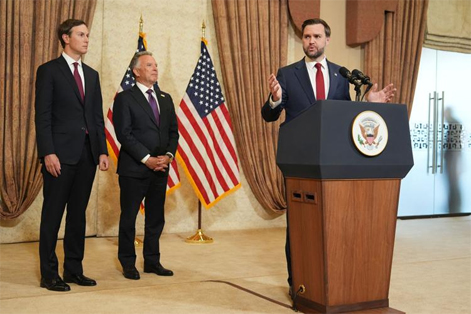
“We need
to see
an
affirmative
commitment
that
they
will not
seek a
nuclear
weapon,
and they
will not
seek the
tools
that
would
enable
them to
quickly
achieve
a
nuclear
weapon,”
Vice
President
JD Vance
said
after
the
21-hour-long
talks.“
(Pool
Photo) |
| |
US-Iran
Talks
Collapse
After 21
Hours,
Leaving
Ceasefire
in Doubt
Daoud
Al-Jaber
- Middle
East
Affairs
Analysis
Tell Us
Worldwide
News
Network
ISLAMABAD
- U.S.
and
Iranian
negotiators
concluded
marathon
talks in
Pakistan’s
capital
on
Sunday
without
reaching
an
agreement,
leaving
a tense
ceasefire
in doubt
and
heightening
worries
over the
Strait
of
Hormuz
and the
wider
regional
standoff.
The
discussions
stretched
for
about 21
hours
and were
presented
as the
most
significant
direct
U.S.-Iran
engagement
in
years.
They
were
held
under
tight
security
in
Islamabad,
with
Pakistani
officials
playing
host as
both
sides
sought
to test
whether
diplomacy
could
slow the
escalating
crisis.
Vice
President
JD
Vance,
who
headed
the
American
delegation,
said the
negotiations
failed
to
bridge
major
gaps.
Iranian
officials
responded
that
Washington
had
pressed
for
terms
Tehran
could
not
accept.
Both
sides
appeared
to leave
the
table
still
far
apart on
the core
issues.
At the
center
of the
talks
were
questions
involving
Iran’s
nuclear
program,
sanctions
relief,
the
future
of the
ceasefire,
and the
security
of the
Strait
of
Hormuz,
a
critical
passage
for
global
oil
shipping.
The
waterway
has
become
an
especially
sensitive
flashpoint
as
tensions
have
risen
across
the
region.
The
talks
also
unfolded
against
a show
of
force.
Trump
said
U.S.
forces
were
“clearing”
the
Strait
of
Hormuz,
while
U.S.
military
officials
said
warships
had
passed
through
the area
as part
of
mine-clearing
preparations.
That
backdrop
underscored
how
closely
diplomacy
and
military
pressure
were
moving
in
tandem.
Pakistan,
which
hosted
the
talks,
continued
to
present
itself
as a
conduit
for
stability
and said
it would
keep
supporting
efforts
to
preserve
the
ceasefire.
But with
no deal
reached,
the
immediate
outlook
remains
uncertain,
and
diplomats
now face
the
possibility
that the
conflict
could
widen
further
if talks
do not
resume
soon.
|
|
|
|
|
|
|
|
|




 I
HI TECH NEWS
I
SPORTS
I
I
HI TECH NEWS
I
SPORTS
I