|
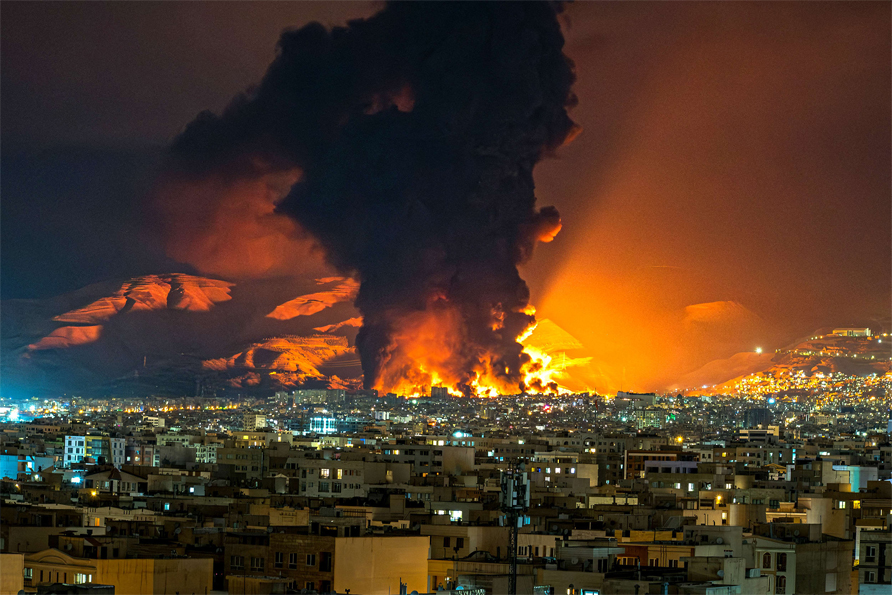
Smoke
and
flames
rise at
the site
of
airstrikes
on an
oil
depot in
Tehran
on
Saturday.
Sasan /
Middle
East
Images /
AFP via
Getty
Images |
|
|
|
|
|
 |
 |
 |
|
|
|
|
|
|
|
|
|
|
| |
Analysis:
Iran's
Strait
Blockade
Outfoxes
Trump:
Deadline
Delay
Masks
U.S.
Missteps
Daoud
Al-Jaber
-
U.S./Middle
East
Affairs
Analysis
Tell Us
Worldwide
News
Network
TEHRAN
and
WASHINGTON
- Amid
the
escalating
U.S.-Iran
conflict,
President
Trump’s
recent
five-day
extension
of his
deadline
for
strikes
on
Iranian
power
facilities
reveals
a
high-stakes
game of
signaling,
backchannel
probing,
and
calculated
denial
far more
than any
genuine
diplomatic
thaw.
Backchannels
Amid
Public
Denials
Trump
has
explicitly
linked
potential
attacks
on
Iran’s
energy
infrastructure
to
Tehran’s
reopening
of the
Strait
of
Hormuz,
calling
recent
talks
“productive”
while
pushing
back the
deadline.
Iranian
state
media
and
officials
counter
that no
substantive
discussions
are
underway,
framing
the
pause as
a U.S.
retreat
under
pressure.
This
contradiction
points
to
likely
indirect
contacts
via
mediators
like
Oman,
where
Tehran
can test
waters
without
admitting
weakness—classic
deniability
in a
conflict
where
public
concessions
carry
lethal
domestic
costs.
Washington
seeks
leverage
on
shipping
and
de-escalation;
Tehran
aims to
outlast
through
attrition.
Trump’s
Pivot
from
Miscalculation
Evidence
mounts
that
Trump’s
national
security
team
underestimated
Iran’s
resolve
to
weaponize
Hormuz
despite
its own
oil
export
dependency.
Pre-war
Pentagon
models
assumed
Tehran
would
fold
after
threats,
downplaying
the
Islamic
Republic’s
“endurance
strategy”:
mine the
strait,
harass
tankers
via
proxies,
absorb
strikes,
and
spike
global
energy
prices
to erode
U.S. and
Gulf
resolve.
Reliance
on a
tight
advisory
circle
sidelined
Treasury
and
Energy
warnings,
echoing
U.S.
blind
spots in
Iraq and
Afghanistan.
The
bravado—“disruptions
are
temporary”—has
given
way to
reactive
measures,
including
power
plant
threats
as a
sharper
economic
knife
without
full
invasion.
Iran’s
Asymmetric
Edge
Tehran’s
blockade
has
clogged
the
world’s
most
vital
oil
chokepoint,
forcing
U.S.
escorts
and
hammering
markets
far
beyond
forecasts.
New
leadership
has
doubled
down on
defiance,
turning
self-inflicted
pain
into a
test of
wills.
Iran
denies
talks to
preserve
legitimacy
at home
and
ambiguity
abroad,
insisting
Hormuz
reopens
on its
terms—not
under
fire.
This
isn’t
negotiation;
it’s a
bid to
prove
Washington’s
military
dominance
can’t
dictate
economic
surrender.
Brinkmanship’s
Next
Move
The war
now
hinges
on
escalation
control:
Hormuz
shipping,
infrastructure
pain,
and who
blinks
on
absorbing
costs.
Allies’
reluctance
to join
escorts
exposes
U.S.
limits,
while
Trump’s
extension
buys
time for
a narrow
off-ramp—perhaps
shipping
concessions
tied to
a
ceasefire.
Without
it,
expect
more
feints
before
the next
missile
salvo.
In
conflicts
like
this,
missiles
shape
the
battlefield,
but
messaging
wins the
long
game.
|
|
|
|
|
|
|
|
|

 I
HI TECH NEWS
I
SPORTS
I
I
HI TECH NEWS
I
SPORTS
I