| |
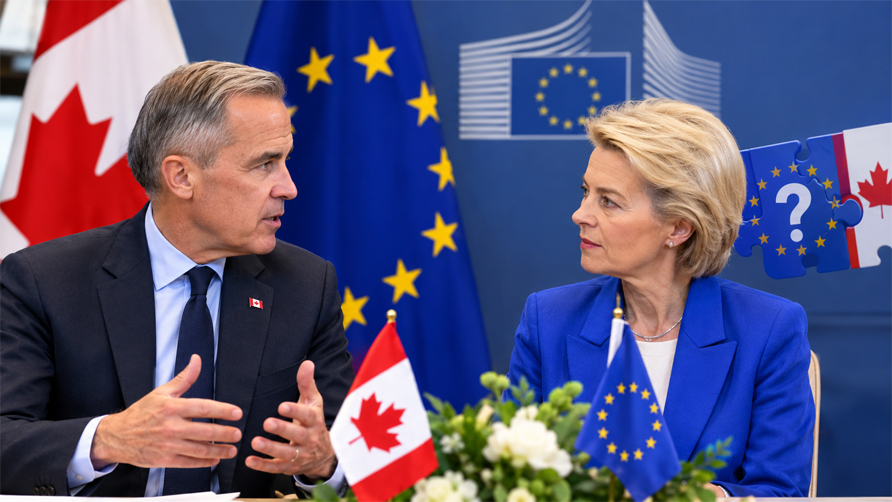
Canada
seeks
broader
EU
partnership
as
questions
grow
over
possible
membership
Patricia
Romero -
International
-
Politics
Tell Us
Worldwide
News
Network
OTTAWA -
Rumors
that
Canada
is
preparing
to join
the
European
Union
have
gained
attention
as Prime
Minister
Mark
Carney
steps up
outreach
to
European
leaders,
but
there is
no
public
evidence
that
Ottawa
has
launched
a formal
bid for
EU
membership.
Instead,
Canada
and the
27-nation
bloc are
pursuing
a
broader
economic,
security
and
political
partnership
amid
trade
friction
with the
United
States
and a
shared
interest
in
diversifying
supply
chains,
defense
procurement
and
investment
relationships.
Carney
is
scheduled
to
travel
to
Strasbourg,
France,
from
Sept.
15-17,
where he
will
address
the
European
Parliament,
attend
European
Commission
President
Ursula
von der
Leyen’s
annual
State of
the
European
Union
address
and meet
with
lawmakers.
The
Canadian
government
says the
visit
will
focus on
strengthening
ties in
trade,
investment
and
security.
The
speculation
has
grown as
Canadian
officials
emphasize
closer
ties
with
Europe
and as
Carney
avoids
ruling
out
every
long-term
option.
But
membership
is not
the
policy
now
being
publicly
advanced.
Canada’s
foreign
minister,
Anita
Anand,
has said
EU
membership
is “not
on the
front
burner.”
Carney,
when
asked
about
the
prospect,
has
instead
spoken
of using
coming
months
to
explore
a
deepening
partnership
with
Europe
across a
range of
areas.
The
legal
and
political
obstacles
to
actual
membership
would be
substantial.
Article
49 of
the
Treaty
on
European
Union
says
that any
European
state
respecting
the
bloc’s
values
may
apply to
join.
Canada’s
location
in North
America
makes it
an
unusual
— and
likely
legally
contentious
—
candidate.
Full
accession
would
also
require
unanimous
approval
from all
EU
member
states
and a
lengthy
process
of
adopting
EU rules
and
institutions.
The
relationship
is
becoming
materially
closer.
At the
2025
Canada-EU
summit,
the two
sides
launched
a
Strategic
Partnership
of the
Future
and a
Security
and
Defence
Partnership
covering
trade,
technology,
energy
and
security
cooperation.
Canada
also
became
the
first
non-European
country
to join
the EU’s
Security
Action
for
Europe,
or SAFE,
defense
initiative
in
February.
The
Canadian
government
is
highlighting
the
economic
value of
the
relationship
as it
tries to
reduce
reliance
on the
United
States.
The EU
was
Canada’s
second-largest
global
trading
partner
for
goods
and
services
in 2025,
accounting
for
about
$178
billion
in
two-way
trade,
according
to the
Prime
Minister’s
Office.
The EU
was also
Canada’s
second-largest
source
of
foreign
direct
investment,
behind
the
United
States.
Potential
areas
for
expanded
cooperation
include
defense
procurement
and
industrial
production,
critical
minerals
and
secure
supply
chains,
energy
exports,
artificial
intelligence,
cybersecurity,
digital
infrastructure,
investment,
research,
regulatory
alignment,
and
Arctic
and
transatlantic
security.
Canada
is
expected
to host
a
Canada-EU
summit
Oct.
29-30,
where
officials
could
provide
more
detail
on the
planned
partnership.
The more
realistic
outcome
is a
special
association
or a
further
expansion
of the
existing
Canada-EU
trade
and
security
framework,
rather
than
Canada
becoming
an EU
member
state.
The two
sides
already
operate
under
the
Comprehensive
Economic
and
Trade
Agreement,
known as
CETA,
which
has been
provisionally
in
effect
since
2017.
Canadian
and
European
officials
are
discussing
ways to
deepen
cooperation
beyond
that
pact,
though
Canada’s
economy
remains
tightly
connected
to the
United
States
because
of
geography,
infrastructure
and
longstanding
cross-border
trade
patterns.
Some
analysts
have
raised
the
theoretical
possibility
of
Canada
moving
toward
arrangements
resembling
the
European
Economic
Area,
whose
members
participate
in parts
of the
EU
single
market.
But an
EU
official
said
such a
model is
not
currently
on the
table.
The
claim
that
Canada
is
looking
to join
the
European
Union
overstates
the
present
situation.
Ottawa
is
clearly
seeking
a closer
strategic
relationship
with
Europe,
driven
by trade
diversification,
security
concerns
and
worsening
uncertainty
in the
Canada-U.S.
relationship.
But
neither
Canada
nor the
EU has
announced
a formal
membership
process,
and full
EU
accession
remains
legally,
geographically
and
politically
improbable.
|




 I
HI TECH NEWS
I
SPORTS
I
I
HI TECH NEWS
I
SPORTS
I