|
|
|
|
|
|
 |
|
|
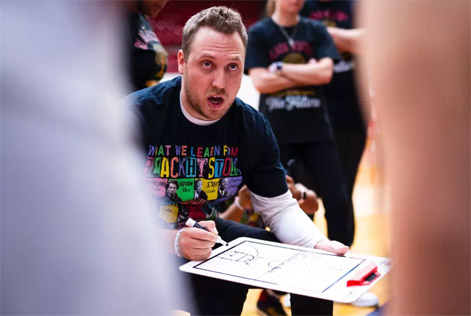
Kiefer
Haffey,
head
women's
basketball
coach,
addresses
the team
ahead of
tipoff.
(Photo
by Jack
Moreland/Detroit
Mercy
Athletics) |
|
|
The
Beginning
of
Something
Special:
A Look
at
Detroit
Mercy
Women's
Basketball
By
Al
Nelson
Tell Us
Detroit
News
Bureau
DETROIT
- On
August
5, I had
an
opportunity
to
attend a
University
of
Detroit
Mercy
Lady
Titans
practice.
I was
not
there to
watch
basketball.
I wanted
to
better
understand
the
people
behind
the
program
and the
direction
Head
Coach
Kiefer
Haffey
and his
staff
are
taking
it.
During
the
practice,
I spoke
with
Coach
Haffey,
Assistant
Coach
and
Director
of
Player
Development
Antonio
“Ton”
Capaldi,
several
players,
and
others
involved
with the
program.
Two days
later, I
golfed
with
Coach
Ton
during
the
University’s
annual
golf
outing,
which
gave us
several
hours to
continue
our
conversation
outside
the
gymnasium.
Together,
those
experiences
gave me
a much
different
perspective
on what
is
taking
place
within
Detroit
Mercy
women’s
basketball.
We
naturally
judge
athletic
programs
by wins,
losses,
conference
standings,
and
postseason
success.
Those
measurements
matter,
but they
show us
the
finished
product
rather
than
everything
that
goes
into
producing
it.
What
struck
me
during
my time
around
the Lady
Titans
was the
genuine
friendship
among
the
coaches,
the
respect
between
coaches
and
players,
and an
obvious
effort
to
create
an
environment
where
individual
improvement
contributes
to
better
teamwork.
Coach
Haffey
has a
vision
for
where he
wants
this
program
to go,
but
perhaps
more
importantly,
the
people
around
him
appear
to
understand
and
share
it.
The
composition
of the
staff is
also
interesting.
Assistant
Coach
and
Recruiting
Coordinator
Juanita
Cochran
brings
extensive
women’s
basketball
experience
and
strong
ties to
this
community.
Assistant
Coach
Tania
Davis
brings a
different
perspective,
including
her
experience
at Iowa
during
the
Caitlin
Clark
era and
the
extraordinary
growth
of that
program
and
women’s
basketball
generally.
Former
Lady
Titan
Latifa
Amzil
now
serves
as
Graduate
Assistant
Coach
and
Director
of
Basketball
Operations,
while
Brendha
Schwartz
serves
as a
Student
Assistant
Coach.
Their
presence,
along
with the
other
members
of the
staff,
provides
these
young
women
with
different
experiences
and
perspectives
from
people
who
share a
common
objective.
As
the year
progresses,
I hope
to
introduce
our
readers
to more
of these
coaches,
players,
and
others
surrounding
the
program.
For now,
my
purpose
is not
to tell
each of
their
stories,
but to
begin
telling
the
story
they are
creating
together.
One
of my
most
interesting
conversations
during
the
August 5
practice
was with
Graduate
Assistant
Strength
Coach
Madi
Bezilla.
As a
man, I
had
never
really
considered
some of
the
physiological
factors
involved
in
training
female
athletes.
I had
generally
thought
about
strength
and
conditioning
in
conventional
terms:
exercise,
conditioning,
nutrition,
recovery,
and
becoming
stronger.
Madi
explained
that
effectively
training
women
also
requires
an
understanding
of
normal
physiological
and
hormonal
changes
that
occur
throughout
the
month
and how
those
changes
may
affect
an
individual
athlete’s
energy,
recovery,
sleep,
and
response
to
training.
The
point is
not to
treat
those
normal
differences
as
limitations,
but to
understand
them
well
enough
to
recognize
what an
athlete
may be
experiencing
and
determine
how best
to
support
her
while
continuing
to
pursue
improvement.
That
conversation
stayed
with me
because
it
illustrated
how
little
we see
as
spectators.
We may
watch an
athlete
on a
particular
day and
conclude
that she
appears
tired or
is
simply
not
performing
at her
usual
level.
Someone
who
knows
that
athlete
and
understands
what may
be
occurring
physiologically
may see
something
entirely
different.
That
does not
mean
lowering
expectations.
It means
having
enough
knowledge
about
the
person
you are
coaching
to help
her meet
those
expectations.
I
left my
conversation
with
Madi
with a
much
greater
appreciation
for the
science,
observation,
and
individual
attention
that go
into
preparing
female
athletes
to
compete
at this
level.
That
lesson
also
helped
me
better
understand
what
Coach
Haffey
appears
to be
building.
Basketball
development
is
obviously
important,
but
these
players
are
surrounded
by
people
responsible
for far
more
than
teaching
them how
to
shoot,
defend
or
rebound.
Coaches
recruit
and
teach.
Coach
Ton
focuses
on
player
development.
Strength
coaches
prepare
them
physically.
Athletic
trainers
help
keep
them
healthy.
Graduate
assistants,
academic
personnel
and
others
handle
responsibilities
that
most
spectators
will
never
see.
What
ultimately
appears
on the
court is
the
collective
result
of all
of those
efforts.
The
Lady
Titans
themselves
are an
intriguing
group of
young
women
from
Michigan,
other
parts of
the
country
and
other
nations.
They
bring
different
backgrounds,
personalities,
experiences
and
ambitions
to
Detroit
Mercy.
Some
are
returning
players;
others
are
newcomers.
Each
wants an
opportunity
to
succeed
individually,
but the
challenge
for
every
good
team is
learning
how to
turn
those
individual
abilities
into
collective
success.
From
what I
observed,
that
process
is
already
underway.
My
conversation
with
Coach
Ton
during
the golf
outing
reinforced
much of
what I
had
observed
two days
earlier.
Over
eighteen
holes,
we had
time to
talk
about
player
development,
relationships,
teamwork,
and the
direction
of the
program.
What
impressed
me
throughout
those
two days
was not
simply
what one
coach
told me,
but the
consistency
of what
I heard
and
observed
from
different
people.
Coach
Haffey’s
vision
appears
to be
understood
by the
people
responsible
for
carrying
it
forward.
I
have
learned
over the
years
that if
you want
to
understand
the
future
of an
organization,
it is
sometimes
useful
to
observe
it
before
the
results
become
obvious.
Watch
how its
people
treat
one
another.
Listen
to how
they
speak
about
one
another.
Determine
whether
they are
genuinely
moving
in the
same
direction.
Those
things
do not
guarantee
success,
and
ultimately
the Lady
Titans
will
have to
demonstrate
their
progress
on the
basketball
court.
But they
tell us
something
about
what is
being
built.
When
the
season
begins,
we will
see the
product.
We will
watch
the
games,
celebrate
the
victories,
analyze
the
losses,
and
develop
our
favorite
players.
As the
year
progresses,
I look
forward
to
helping
our
readers
get to
know
more of
these
young
women
and the
coaches
and
others
who
support
them.
For
now,
however,
I am
interested
in the
story
they are
beginning
to write
together.
After
spending
those
two days
around
the
program,
I walked
away
believing
that I
may have
witnessed
the
beginning
of
something
special.
Author
Bio &
Contact:
Al
Nelson
is a
proud
two-time
graduate
of the
University
of
Detroit
Mercy
(B.A.
’72,
M.A.
’76), an
attorney,
author,
and
contributor
to
TellUsDetroit.
Email:
anelson@tellususa.com
|
|
|
|
|
|
|
|
|




 I
HI TECH NEWS
I
SPORTS
I
I
HI TECH NEWS
I
SPORTS
I