|
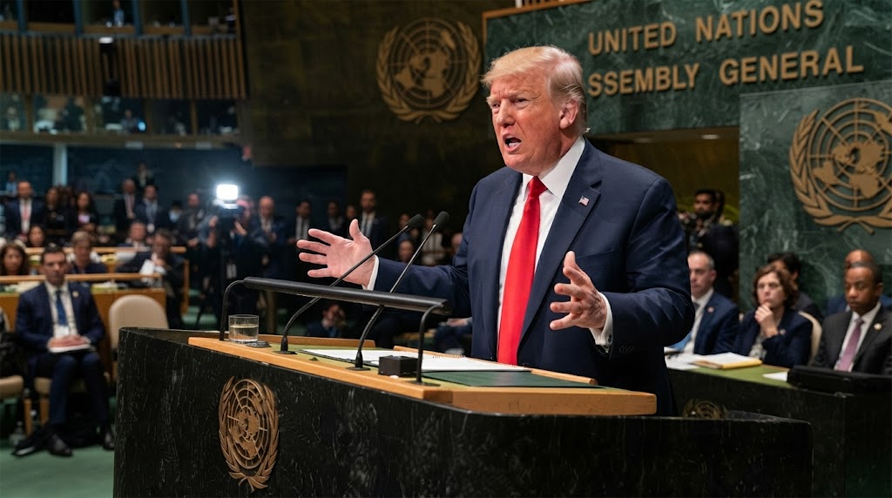
For
roughly
37
minutes,
Trump
ricocheted
from war
to
trade,
artificial
intelligence
to
Greenland,
Cuba to
Venezuela,
with
little
of the
traditional
diplomatic
architecture
expected
from an
American
president
addressing
the
General
Assembly.
(Tell Us
USA Ai
image) |
|
|
|
|
|
 |
 |
 |
|
|
|
|
|
|
|
|
|
|
| |
Trump’s
U.N.
Speech
Becomes
a
Showcase
of
Threats,
Grievances
and Raw
Power
Ashley
Roberts
- UN
Correspondent
Tell Us
USA News
Network
UNITED
NATIONS
-
President
Donald
Trump
came to
the
United
Nations
on
Tuesday
to make
the case
for
American
leadership.
Instead,
he
delivered
a
bruising
display
of the
transactional,
confrontational
worldview
that has
defined
his
return
to power
—
threatening
to
“annihilate”
Iran,
disparaging
international
institutions,
needling
allies
and
turning
a global
diplomatic
forum
into
another
Trump
grievance
session.
For
roughly
37
minutes,
Trump
ricocheted
from war
to
trade,
artificial
intelligence
to
Greenland,
Cuba to
Venezuela,
with
little
of the
traditional
diplomatic
architecture
expected
from an
American
president
addressing
the
General
Assembly.
There
was no
sustained
appeal
for
allied
unity,
no
detailed
road map
for
ending
the wars
consuming
the
Middle
East and
Europe,
and
little
acknowledgment
that
Washington’s
actions
carry
consequences
beyond
the
applause
lines at
home.
There
was,
instead,
a clear
message
to the
world:
Trump
sees
American
power
not as a
tool for
coalition-building,
but as
leverage
—
something
to be
wielded,
advertised
and,
when
necessary,
threatened.
The most
striking
passage
came
when
Trump
spoke
about
Iran.
Defending
the
U.S.-Israeli
campaign
against
Tehran,
Trump
said he
faced a
“big
decision”:
reach an
agreement
that
would
allow
Iran to
rebuild,
or
“annihilate
the
Islamic
Republic”
and
“drive
them
into
hell.”
It was a
remarkable
formulation
from the
podium
of an
institution
created
from the
ashes of
World
War II
to
prevent
precisely
that
kind of
escalation.
Trump
presented
the
threat
as a
negotiating
tactic,
insisting
he still
expected
a deal
with
Tehran.
But the
language
underscored
the
central
contradiction
of his
foreign
policy:
He
regularly
touts
himself
as a
dealmaker
while
employing
rhetoric
that
narrows
the
space
for
diplomacy
and
makes
compromise
politically
perilous
for the
other
side.
The
president
appeared
more
interested
in
projecting
dominance
than
explaining
what a
durable
settlement
would
look
like,
how it
would be
enforced
or what
role
U.S.
allies
and
international
institutions
might
play.
Trump’s
speech
was also
an
attack
on the
machinery
of
global
diplomacy
itself.
He
denounced
the
International
Criminal
Court as
an “out
of
control
institution”
and an
“evil
group of
people,”
while
portraying
the
United
Nations
as
captive
to
“far-left”
and
globalist
forces.
He
nevertheless
said the
U.N. had
“great
potential”
— a
familiar
Trump
formulation
that
suggests
he views
multilateral
organizations
as
acceptable
only
when
they
validate
American
priorities.
The
contradiction
was not
accidental.
Trump’s
view of
the
international
order
has long
been
rooted
in a
simple
calculation:
Agreements,
alliances
and
institutions
are
valuable
only
insofar
as they
produce
an
immediate
and
visible
gain for
the
United
States.
That
view may
resonate
with his
political
base.
But it
leaves
allies
wondering
whether
they are
partners
or
merely
parties
to the
next
negotiation.
The
president’s
address
lurched
through
a list
of
geopolitical
disputes
with the
rhythm
of a
campaign
rally.
He vowed
that the
United
States
would
not
permit
threats
to gain
a
foothold
in the
Western
Hemisphere,
wrapping
Venezuela,
Cuba,
Mexico
and
regional
security
into a
sweeping
warning
backed
by what
he
called
America’s
“unmatched
military
might.”
He
assailed
Cuba as
a failed
state,
prompting
the
Cuban
delegation
to leave
the
hall. He
again
invoked
Greenland,
a
subject
that has
become
shorthand
for
Trump’s
preference
for
territorial
and
economic
bargaining
over
diplomatic
convention.
He also
offered
broad
assurances
about
Ukraine,
saying
he
believed
the war
could be
resolved
more
quickly
than
most
assume.
Yet he
provided
no new
framework
for
negotiations,
no
detail
about
security
guarantees
and no
explanation
of how
he would
reconcile
a
cease-fire
with the
sovereignty
concerns
that
have
kept the
conflict
unresolved.
The
result
was a
speech
heavy on
certainty
and
remarkably
light on
policy.
Trump’s
detour
into
artificial
intelligence
was
revealing.
He said
his
administration
would
use the
term
“super
intelligence,”
rather
than
artificial
intelligence,
and
dismissed
safety
concerns
as a
“hoax.”
It was
an odd
aside in
a speech
ostensibly
focused
on the
most
pressing
security
challenges
facing
the
world.
But it
captured
Trump’s
governing
style:
complicated
subjects
are
compressed
into
branding
exercises,
skepticism
is
recast
as
weakness,
and
caution
becomes
an enemy
of
strength.
Trump
was not
speaking
to the
General
Assembly
alone.
He was
speaking
over it
— to a
domestic
audience
accustomed
to
seeing
global
affairs
through
the lens
of
combat,
dominance
and
cultural
confrontation.
That may
be
politically
effective.
It is
less
clear
that it
is
diplomatically
effective.
The U.N.
address
was not
an
invitation
to
collective
action.
It was a
warning.
Trump’s
message
to
friends
and
adversaries
alike
was that
the
United
States
intends
to act
with
fewer
restraints,
less
patience
for
international
consensus
and a
greater
willingness
to
convert
military
and
economic
power
into
political
pressure.
For
diplomats
in the
hall,
the
speech
offered
a
familiar
Trump
doctrine
stripped
of any
remaining
subtlety:
America
first,
institutions
last,
and
diplomacy
only
insofar
as it
produces
a deal
Trump
can
claim as
his own.
This
Tell Us
USA News
Network
report
is
produced
in part
by Ai
and can
make
mistakes.
Please
contact
and let
us know
of any
errors
you may
find.
info@tellususa.com
|
|
|
|
|
|
|
|
|

 I
HI TECH NEWS
I
SPORTS
I
I
HI TECH NEWS
I
SPORTS
I