|
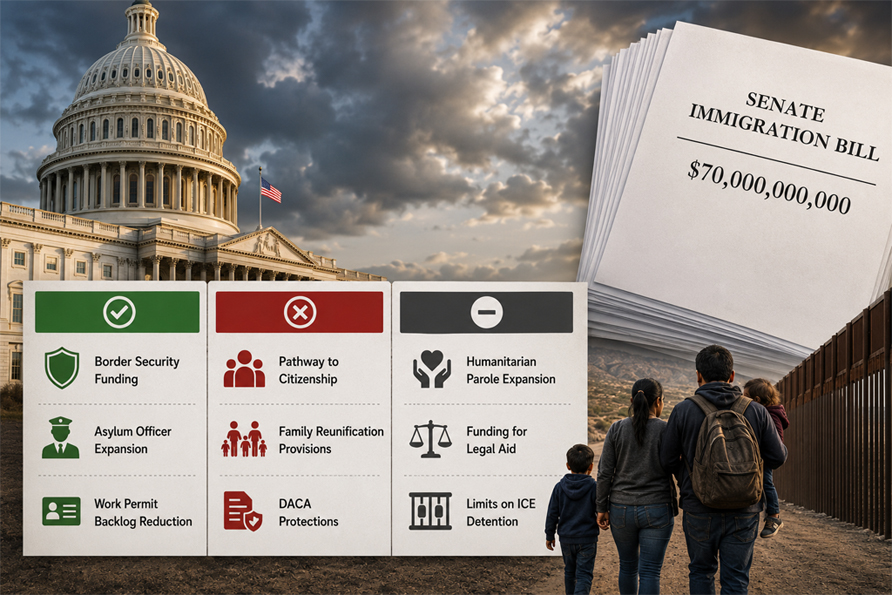
A visual
breakdown
of the
Senate’s
$70
billion
immigration
bill,
highlighting
the
provisions
that
passed,
the
proposals
that
failed,
and the
measures
removed
during
negotiations.
(AI
images
produced
by Tell
Us USA
News
Network) |
|
|
|
|
|
 |
 |
 |
|
|
|
|
|
|
|
|
|
|
| |
Inside
the $70
Billion
Senate
Immigration
Bill:
What
Passed,
What
Failed,
What Got
Stripped
Ashley
Roberts
-
Capitol
Hill
Tell Us
USA News
Network
WASHINGTON
--
Following
a
marathon,
18-hour
voting
session
that
stretched
overnight,
the U.S.
Senate
early
this
morning
passed a
major 70
billion
dollar
immigration
enforcement
package.
The vote
capped
off
weeks of
internal
gridlock,
a
dramatic
vote-a-rama
on
dozens
of
amendments,
and
high-profile
intra-party
fracturing
over
independent
funds
tied to
the
White
House.
The
centerpiece
of the
session
was a
massive
budget
reconciliation
package
designed
to fully
fund
federal
immigration
enforcement
agencies.
The bill
ultimately
advanced
along
narrow
party
lines,
with 53
votes in
favor
and 47
against.
Alaska
Republican
Senator
Lisa
Murkowski
cast the
lone GOP
vote
against
it. The
package
funnels
roughly
70
billion
dollars
into
Immigration
and
Customs
Enforcement
and
Customs
and
Border
Protection.
The
funding
is
structured
to
extend
through
the
remainder
of the
current
presidential
term.
The bill
now
heads to
the
House of
Representatives,
where
Republican
leadership
indicated
a vote
could
occur as
early as
next
week.
The
legislation
had
previously
been
derailed
by
fierce
controversy
surrounding
a
proposed
1.8
billion
dollar
anti-weaponization
payout
fund.
The fund
originated
from an
out-of-court
settlement
resolving
a 10
billion
dollar
lawsuit
brought
by
President
Trump
against
the IRS
over the
2019
leak of
his tax
records.
The pool
of money
drew
severe
bipartisan
backlash
over
concerns
that the
administration
could
distribute
taxpayer
dollars
to
political
allies,
including
individuals
convicted
in the
January
6, 2021,
Capitol
riot.
Senate
Minority
Leader
Chuck
Schumer
introduced
an
amendment
to
legally
bar the
creation
of the
fund.
Despite
three
swing-state
Republicans
-- Susan
Collins
of
Maine,
Jon
Husted
of Ohio,
and Dan
Sullivan
of
Alaska
--
breaking
ranks to
vote
with
Democrats,
the
amendment
failed
after a
tense,
three-hour
floor
huddle
led by
Senate
Majority
Leader
John
Thune.
Senator
Thom
Tillis
immediately
introduced
a
separate
amendment
to
redirect
that 1.8
billion
dollars
toward
Justice
Department
fraud
prevention
instead.
While 11
Republicans
backed
it,
Democrats
rejected
the
reallocation,
causing
the
amendment
to fail
49 to
50.
Though
the
legislative
bans
failed,
Acting
Attorney
General
Todd
Blanche
testified
earlier
in the
week
that the
administration
would
drop
plans
for the
fund.
However,
ongoing
mixed
signaling
from the
White
House
left
senators
on both
sides
seeking
legal
permanence.
Lawmakers
successfully
eliminated
a
heavily
criticized
provision
that
would
have
allocated
1
billion
dollars
in
security
funding
for the
White
House,
which
included
money
allocated
for
construction
on a new
East
Wing
ballroom.
Both
Democrats
and
rank-and-file
Republicans
questioned
the
optics
of using
taxpayer
money
for a
massive
luxury
project
during a
time of
economic
hardship
for
voters.
Leadership
ultimately
agreed
to drop
the
ballroom
funds
from the
final
package
to
preserve
the
unity
needed
to pass
the
broader
immigration
bill.
During
the
grueling
amendment
process,
several
notable
measures
were
brought
forward
but fell
short of
the
60-vote
threshold
required
to waive
the
Budget
Act. An
amendment
by
Senator
Bernie
Sanders
to cap
contributions
to
SuperPACs
failed
on a
party-line
45 to 53
vote. An
amendment
introduced
by
Senator
Mark
Warner
that
would
prohibit
an
individual
from
serving
as the
Director
of
National
Intelligence
while
simultaneously
heading
another
federal
department
failed
in a
dead-even
49 to 49
tie. A
motion
to waive
the
budget
rules
for an
amendment
relating
to the
SAVE Act
of 2026,
brought
by
Senator
Lindsey
Graham,
failed
48 to
50.
Amidst
the
high-stakes
political
maneuvering,
the
chamber
paused
briefly
Thursday
evening
to pay
bipartisan
tribute
to
Senator
Susan
Collins,
who
successfully
cast her
10,000th
consecutive
vote in
the U.S.
Senate.
Collins
has not
missed a
single
roll-call
vote
since
entering
office
in 1997.
|
|
|
|
|
|
|
|
|

 I
HI TECH NEWS
I
SPORTS
I
I
HI TECH NEWS
I
SPORTS
I