|
|
|
|
|
|
|
|
|
|
|
|
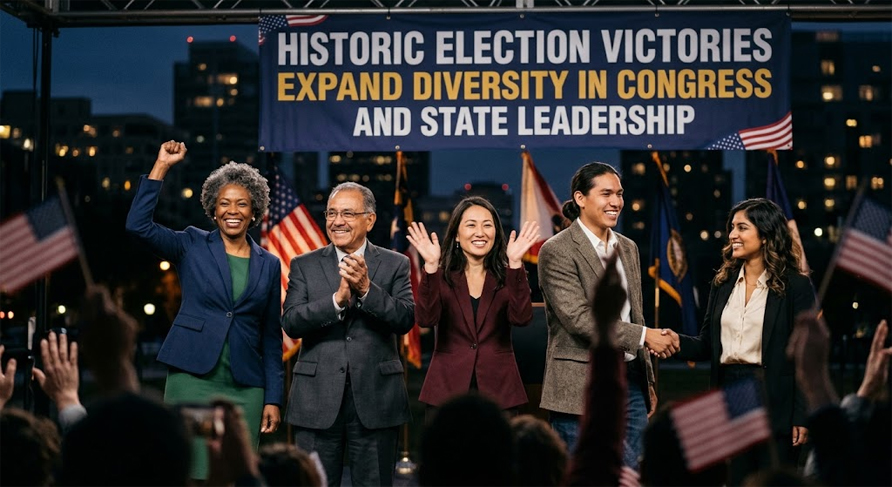
Historic
election
victories
expand
diversity
in
Congress
and
state
leadership
Ashley
Roberts
-
Capitol
Hill
Correspondent
Tell Us
USA News
Network
WASHINGTON
- Voters
have
delivered
a series
of
historic
breakthroughs
in
American
politics,
electing
Keisha
Lance
Bottoms
as the
nation’s
first
Black
female
governor
and
Abdul
El-Sayed
as the
first
Muslim
elected
to the
U.S.
Senate,
while
positioning
House
Democratic
leader
Hakeem
Jeffries
to
become
the
first
Black
speaker
of the
House.
The
results
mark
advances
in
representation
across
federal
and
state
government.
El-Sayed’s
victory
brings a
religious
milestone
to the
Senate,
while
Jeffries’
potential
speakership
would
break a
racial
barrier
in
congressional
leadership.
Bottoms’
election
represents
a
separate
breakthrough
in state
executive
leadership.
Bottoms,
a
Democrat
and
former
Atlanta
mayor,
defeated
Republican
businessman
Rick
Jackson
to win
Georgia’s
governorship.
She will
succeed
Republican
Gov.
Brian
Kemp,
who was
barred
from
seeking
a third
consecutive
term.
Her
victory
also
returns
the
governor’s
office
to
Democratic
hands
after
more
than two
decades
of
Republican
control.
In
Michigan,
El-Sayed,
a
physician
and
former
public
health
official,
defeated
Republican
former
U.S.
Rep.
Mike
Rogers.
The son
of
Egyptian
immigrants,
El-Sayed
will
enter
the
Senate
when the
new
Congress
takes
office
in
January,
adding a
new
dimension
to
religious
representation
in the
chamber.
Jeffries
won
reelection
in New
York and
emerged
from his
party’s
recapture
of the
House
majority
positioned
to
become
speaker.
If
elected
by his
colleagues,
he would
be the
first
Black
lawmaker
to hold
the
office.
His
elevation
is not
automatic.
Winning
reelection
and
leading
the
majority
party do
not
confer
the
speakership.
The new
House
must
choose
its
speaker
in a
separate
vote
when it
convenes
in
January.
Together,
the
outcomes
place
two
confirmed
electoral
firsts
alongside
a
possible
third.
Bottoms
and
El-Sayed
have won
their
races;
Jeffries
still
faces
the vote
that
would
turn his
party’s
electoral
victory
into a
milestone
in
congressional
leadership.
|
|
|
|
|
|
|
|
|




 I
HI TECH NEWS
I
SPORTS
I