|
|
|
|
|
|
 |
|
|
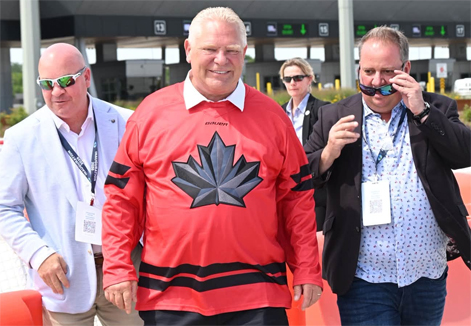
Provincial
leaders,
including
Ontario
Premier
Doug
Ford,
(red
jersey)
expressed
full
backing
for
Ottawa's
retaliatory
stance.
Business
advocacy
organizations
and
economists
on both
sides
warn of
widespread
supply
chain
strain
and
rising
consumer
costs as
midterm
political
campaigns
approach.
(Photo
by
Montez
Miller/Tell
Us USA
News
Network) |
|
|
From
Store
Shelves
to Gas
Pumps:
How 50%
Tariffs
On
Canada
Hits
American
Wallets
Charles
Mosley -
Business/Economy/Money
Tell Us
USA News
Network
DETROIT
/ OTTAWA
—
Tensions
between
the
United
States
and
Canada
escalated
dramatically
as trade
negotiations
collapsed,
triggering
sweeping
50
percent
U.S.
tariffs
on
approximately
20
billion
dollars
worth of
Canadian
imports.
In
response,
Canadian
Prime
Minister
Mark
Carney
suspended
talks,
directed
his
negotiating
team to
return
to
Ottawa,
and
declared
that
Canada
is
preparing
dollar-for-dollar
retaliatory
measures
scheduled
to take
effect
on
September
8.
The
breakdown
occurred
ahead of
a
deadline
set by
the
Trump
administration.
Trade
representatives
from
both
nations
had
worked
through
intensive
sessions
in
Washington
after
President
Trump
granted
a brief
extension
to avert
the
duties.
While
tentative
progress
had been
made,
including
potential
U.S.
tariff
reductions
on
Canadian
steel,
aluminum,
and
automobiles
in
exchange
for
Canada
lifting
provincial
bans on
U.S.
alcohol,
Canadian
officials
stated
that
Washington
introduced
unacceptable
new
demands.
Prime
Minister
Carney
addressed
the
nation,
calling
the
last-minute
U.S.
terms
unfair
and
uneconomic.
Carney
added
that
Washington's
requests
regarding
auto
production,
restrictions
on
Canada's
ability
to
strike
trade
deals
with
third-party
nations,
and
rollbacks
on
cultural
protections
went too
far.
U.S.
Trade
Representative
Jamieson
Greer
countered
that
Canada
had
walked
back
previous
commitments,
noting
that
Canada
declined
to
finalize
the
agreement
under
terms
reached
earlier
in the
week
despite
receiving
favorable
access
offers.
U.S.
officials
confirmed
that no
further
talks
are
currently
scheduled.
The 50
percent
U.S.
tariffs,
enacted
under
Section
338 of
the
Tariff
Act of
1930,
apply to
roughly
5
percent
of
Canada's
annual
exports
to the
U.S..
The
targeted
categories
encompass
electronic
equipment,
agricultural
products,
dairy,
timber,
apparel,
and
specialized
manufactured
goods,
impacting
over 4
billion
dollars
in
electronics
alone.
While
the
majority
of
standard
cross-border
trade
compliant
with the
United
States-Mexico-Canada
Agreement
remains
exempt,
select
goods
previously
protected
under
the pact
are now
subject
to the
new
duties.
From a
macroeconomic
perspective,
Canada
stands
to
absorb
significantly
more
structural
risk in
a
prolonged
trade
dispute.
Trade in
goods
and
services
with the
U.S.
accounts
for the
majority
of
Canada's
export
market,
with
more
than 70
percent
of all
Canadian
exports
heading
south.
In
contrast,
Canadian
exports
represent
less
than 20
percent
of total
U.S.
trade,
supported
by a 28
trillion
dollar
economy
that
offers a
vast
domestic
buffer.
While a
50
percent
duty
directly
threatens
Canadian
GDP
growth,
job
retention,
and
regional
manufacturing,
Canada's
retaliatory
tariffs
on U.S.
steel,
dairy,
appliances,
and
electronics
will
primarily
raise
input
costs
for
domestic
consumers
and
local
businesses.
However,
the U.S.
retains
specific
vulnerabilities.
Cross-border
automotive
supply
chains—where
components
cross
the
border
multiple
times
during
production—face
cost
surges,
while
U.S.
Midwest
industries
remain
reliant
on
Canadian
energy
and raw
materials.
Provincial
leaders,
including
Ontario
Premier
Doug
Ford,
expressed
full
backing
for
Ottawa's
retaliatory
stance.
Business
advocacy
organizations
and
economists
on both
sides
warn of
widespread
supply
chain
strain
and
rising
consumer
costs as
midterm
political
campaigns
approach.
*Portions
of this
news
report
is AI
generated
and can
make
mistakes
|
|
|
|
|
|
|
|
|




 I
HI TECH NEWS
I
SPORTS
I
I
HI TECH NEWS
I
SPORTS
I