|
|
|
|
|
|
|
|
|
|
|
|
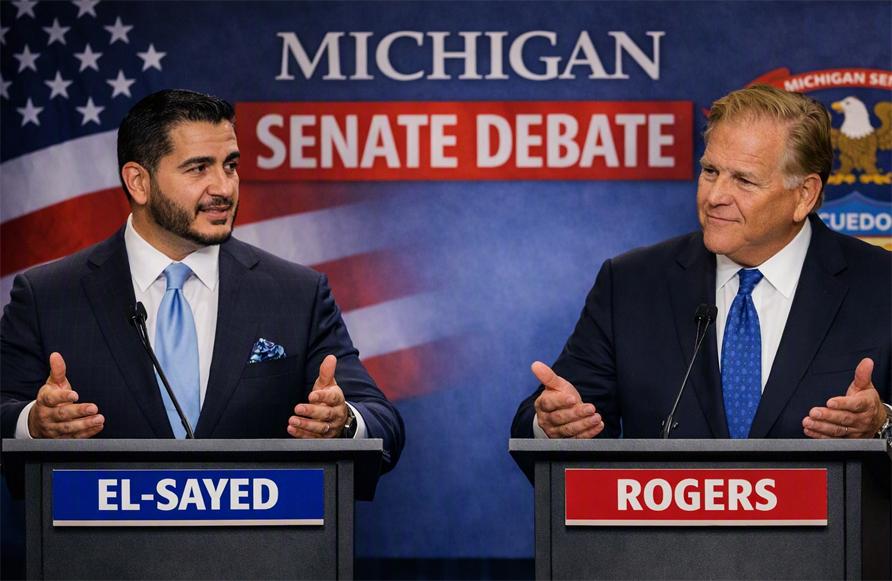
El-Sayed,
Rogers
face
first
debate
tonight
as tight
Michigan
Senate
race
enters
final
stretch
Jean
Davis -
Local/State
Politics
Tell Us
Detroit
News
Bureau
GRAND
RAPIDS,
MI -
Democrat
Abdul
El-Sayed
and
Republican
Mike
Rogers
will
meet
tonight
in their
first
televised
debate,
a
high-stakes
encounter
that
will
test
their
competing
promises
to lower
costs in
Michigan’s
closely
contested
U.S.
Senate
race.
The
hourlong
debate
begins
at 7
p.m.
Eastern
at
WOOD-TV8’s
Grand
Rapids
studios.
The
candidates
are
seeking
to
replace
retiring
Democratic
Sen.
Gary
Peters,
with
less
than
four
weeks
remaining
before
the Nov.
3
election
and
absentee
voting
already
underway.
Recent
polling
suggests
neither
candidate
has a
comfortable
advantage.
A Fox
News
survey
released
Sept. 30
put
El-Sayed
at 50%
and
Rogers
at 49%,
a
difference
within
the
poll’s
margin
of
error.
The Cook
Political
Report
rates
the race
a
toss-up.
Affordability
is
likely
to
dominate
tonight’s
discussion.
Both
candidates
have
focused
on
household
costs,
but they
offer
sharply
different
explanations
for what
is
driving
those
costs
and how
Washington
should
respond.
Their
recent
exchanges
suggest
the
debate
will
also
turn on
whether
voters
see El-Sayed’s
progressive
agenda
or
Rogers’
alignment
with
President
Donald
Trump as
the
greater
risk.
Health
care
offers
one of
the
clearest
policy
contrasts.
El-Sayed,
a
physician
and
former
Detroit
and
Wayne
County
public
health
official,
has made
Medicare
for All
a
centerpiece
of his
campaign,
advocating
a single
government-run
insurance
program
covering
all
Americans.
Rogers,
a former
congressman,
has
emphasized
greater
transparency
in
health
care
pricing
and
lower
prescription
drug
costs,
alongside
proposals
to
encourage
homeownership.
He has
argued
that
Medicare
for All
would be
too
costly.
Expect
Rogers
to press
El-Sayed
on the
price
and
scope of
his
proposals,
while
El-Sayed
seeks to
present
expanded
health
coverage
as an
answer
to
voters’
financial
pressures.
Those
are
likely
lines of
argument
based on
their
campaigns
so far,
rather
than
confirmed
debate
questions.
Trade
and
manufacturing
could
produce
another
pointed
exchange.
El-Sayed
has
criticized
the
Trump
administration’s
trade
war with
Canada,
Michigan’s
largest
export
partner.
Rogers
has
attacked
El-Sayed’s
past
support
for the
Green
New
Deal,
arguing
that it
would
harm the
state’s
auto
manufacturing
industry.
Their
answers
could
reveal
how each
balances
promises
to
protect
Michigan
jobs
with the
potential
costs of
his
party’s
economic
agenda.
For
El-Sayed,
the
debate
is an
opportunity
to
demonstrate
that a
progressive
nominee
can
appeal
beyond
his
strongest
supporters
in a
battleground
state.
He has
faced
concerns
among
some
moderate
Democrats
over
Medicare
for All
and
among
some
Jewish
voters
over his
criticism
of
Israel.
A strong
performance
would
need to
address
those
reservations
while
preserving
his
economic
message.
For
Rogers,
the
challenge
is to
turn
criticism
of
El-Sayed
into a
persuasive
case for
his own
return
to
elected
office.
Rogers
narrowly
lost
Michigan’s
2024
Senate
election
to
Democrat
Elissa
Slotkin
and has
again
received
Trump’s
endorsement.
El-Sayed
has
sought
to make
that
relationship
a
liability
by tying
Rogers
to
administration
policies
he says
have
raised
costs.
The
contrast
is
likely
to
extend
beyond
policy
details.
Rogers
has
portrayed
El-Sayed
as too
far
left,
while
El-Sayed
has
attacked
Rogers’
support
for the
Trump
administration.
Meeting
face-to-face
will
give
each
candidate
a chance
to
challenge
those
characterizations
immediately
and
force
the
other to
answer
outside
the
controlled
setting
of a
campaign
advertisement
or
prepared
speech.
The most
revealing
moments
may come
when the
candidates
move
beyond
familiar
attacks
and
explain
how
their
proposals
would
work. On
health
care,
viewers
should
watch
whether
El-Sayed
addresses
the cost
concerns
surrounding
Medicare
for All
and
whether
Rogers
explains
how his
pricing
and
prescription-drug
proposals
would
translate
into
savings.
On the
economy,
the test
will be
how
effectively
both
connect
national
arguments
about
tariffs,
manufacturing
and
energy
policy
to the
bills
Michigan
households
pay.
The
format
will
reward
concise
answers.
Candidates
will
have 60
seconds
to
respond
to
questions
and 30
seconds
for
follow-ups,
rebuttals
and
closing
statements,
leaving
limited
room for
detailed
explanations.
WOOD-TV8
political
reporter
Rick
Albin
will
moderate,
with
anchor
Amber
Krycka
presenting
questions
from
voters.
The
debate
will air
on
WOOD-TV8,
WOOD TV+
and
partner
stations
across
Michigan,
with
NewsNation
carrying
the
event
nationally.
WOOD’s
online
pre-debate
coverage
begins
at 6:30
p.m.,
followed
by
post-debate
coverage
at 8
p.m.
The
candidates
are also
scheduled
to
debate
Oct. 21
in an
event
hosted
by
Detroit’s
WXYZ-TV.
Tonight
offers
their
first
direct
televised
encounter
at a
moment
when
polling
remains
close
and
voters
are
already
casting
ballots.
This
Tell Us
USA News
Network
report
is
produced
in part
by Ai
and can
make
mistakes.
Please
contact
and let
us know
of any
errors
you may
find.
info@tellususa.com
|
|
|
|
|
|
|
|
|




 I
HI TECH NEWS
I
SPORTS
I
I
HI TECH NEWS
I
SPORTS
I