|
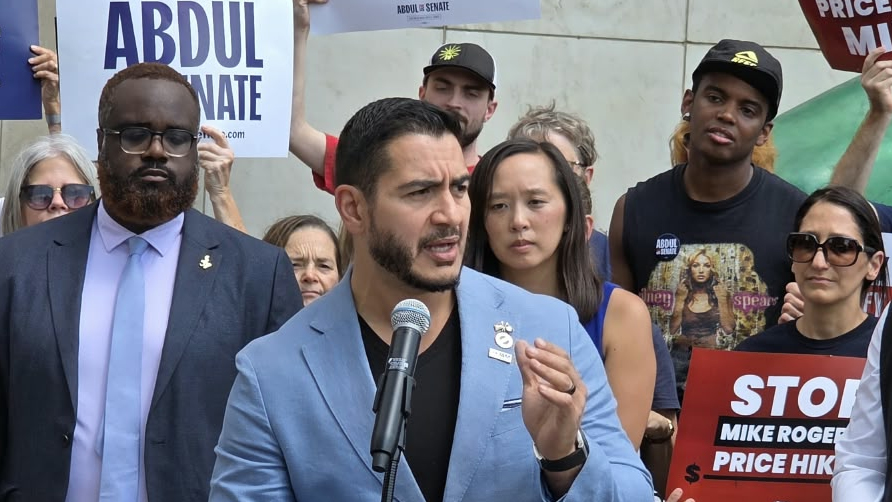
Abdul
El-Sayed's
narrow
Senate
primary
win over
establishment
favorite
Rep.
Haley
Stevens
—
achieved
despite
a wall
of
outside
spending
arrayed
against
him —
has made
him,
almost
overnight,
one of
the
party's
most
consequential
new
figures.
(Photo
by HB
Meeks/Tell
Us USA
News
Network) |
|
|
|
|
|
 |
 |
 |
|
|
|
|
|
|
|
|
|
|
| |
Democrats
Look to
Fresh
New
Fighters
to Lead
the
Party
Forward
Marc
Kennedy
-
National-Politics
Tell Us
USA News
Network
WASHINGTON
-
Democrats,
still
bruised
from a
string
of
national
defeats,
are
placing
their
bets on
a new
crop of
leaders
rather
than a
single
standard-bearer
— a
telling
sign of
a party
still
searching
for its
center
of
gravity.
What's
emerging
isn't a
coronation
but a
contest:
competing
theories
of the
case for
how
Democrats
claw
back
power,
each
backed
by a
different
faction
with its
own read
on what
went
wrong
and what
comes
next.
House
Minority
Leader
Hakeem
Jeffries
is
making
his play
as the
institutionalist's
institutionalist,
rolling
out a
"First
100
Days"
agenda
built
around
shoring
up the
Affordable
Care Act
and
reasserting
federal
policing
oversight.
It's a
bet on
discipline
over
disruption
— the
theory
that
sharper
messaging
and
better
candidate
recruitment,
not
ideological
reinvention,
is what
rebuilds
a
majority.
Maryland
Gov. Wes
Moore,
meanwhile,
is doing
what
ambitious
governors
do in
the
shadow
of a
presidential
cycle:
building
a
national
profile
through
state-level
policy.
His
"Work,
Wages,
and
Wealth"
platform
—
national
service
programs,
capital
for
minority-owned
businesses
— is a
deliberate
synthesis
of
economic
populism
and
racial-justice
politics,
and it's
why his
name
keeps
surfacing
in 2028
speculation
whether
he
encourages
it or
not.
The more
combustible
fight is
happening
on the
left,
where
Bernie
Sanders'
movement
is
facing a
succession
question
with no
clean
answer.
Some
Sanders
loyalists
see Rep.
Alexandria
Ocasio-Cortez
as the
heir
apparent;
others
argue
Rep. Ro
Khanna's
broader
coalition-building
instincts
make him
the more
durable
choice.
It's
less a
personality
clash
than a
strategic
one —
purity
versus
reach —
and it
will
shape
how
aggressively
the
party's
left
flank
pushes
in the
next
cycle.
Then
there's
Michigan.
Abdul
El-Sayed's
narrow
Senate
primary
win over
establishment
favorite
Rep.
Haley
Stevens
—
achieved
despite
a wall
of
outside
spending
arrayed
against
him —
has made
him,
almost
overnight,
one of
the
party's
most
consequential
new
figures.
Democratic
strategists
are
already
parsing
the
result
as proof
that
progressive
candidates
can
still
win
statewide
in a
genuine
battleground,
not just
in safe
blue
districts.
His
coalition
—
younger
voters,
Arab
American
communities,
anti-establishment
Democrats
— is the
kind of
bloc
every
2026
strategist
is now
studying
closely.
But wins
like
this
come
with a
bill
attached.
El-Sayed
inherits
a
divided
state
party
fresh
off a
bruising
primary,
and the
job of
stitching
together
skeptical
centrists,
suburban
moderates,
and
Stevens
loyalists
now
falls
almost
entirely
on him.
How he
handles
that
internal
repair
work may
matter
as much
to
November
as
anything
he says
on the
trail.
The
speed of
his
national
validation
tells
its own
story.
Calls
from
Barack
Obama,
Chuck
Schumer,
Kamala
Harris,
and Gov.
Gretchen
Whitmer
aren't
just
courtesy
outreach
—
they're
a signal
that
party
leadership
sees
Michigan,
and
El-Sayed
specifically,
as
pivotal
to any
path
back to
a Senate
majority.
El-Sayed
has said
the
Obama
call
left him
energized,
and he's
angling
for the
former
president
to
campaign
with him
this
fall — a
request
that, if
granted,
would
carry
real
weight
in a
state
Democrats
can't
afford
to lose.
That's
what
makes
El-Sayed's
next few
months a
genuine
test
case.
Can he
expand
past his
progressive
base to
independents,
Black
voters,
and
suburban
moderates
— even
peel off
some
disaffected
Republicans?
If he
can, it
strengthens
the
argument
that
insurgent
progressives
can win
where it
counts.
If he
can't,
expect
establishment
Democrats
to seize
on it as
evidence
for a
return
to
safer,
more
centrist
recruits.
Zoom
out, and
the
pattern
is
unmistakable:
no
single
leader,
no
unified
strategy,
just a
constellation
of
rising
figures
—
Jeffries
the
tactician,
Moore
the
executive,
El-Sayed
the
insurgent
— each
testing
a
different
theory
of how
Democrats
rebuild
trust
with
voters
who've
stopped
taking
their
promises
at face
value.
Whether
the
party's
next
chapter
is
written
by
pragmatists
or
firebrands
is still
an open
question.
But as
the 2026
midterms
approach,
Michigan
— and
El-Sayed's
ability
to hold
his
fractured
coalition
together
— may
end up
being
the
closest
thing to
an
answer
Democrats
get.
|
|
|
|
|
|
|
|
|

 I
HI TECH NEWS
I
SPORTS
I
I
HI TECH NEWS
I
SPORTS
I