|
|
|
|
|
|
 |
|
|
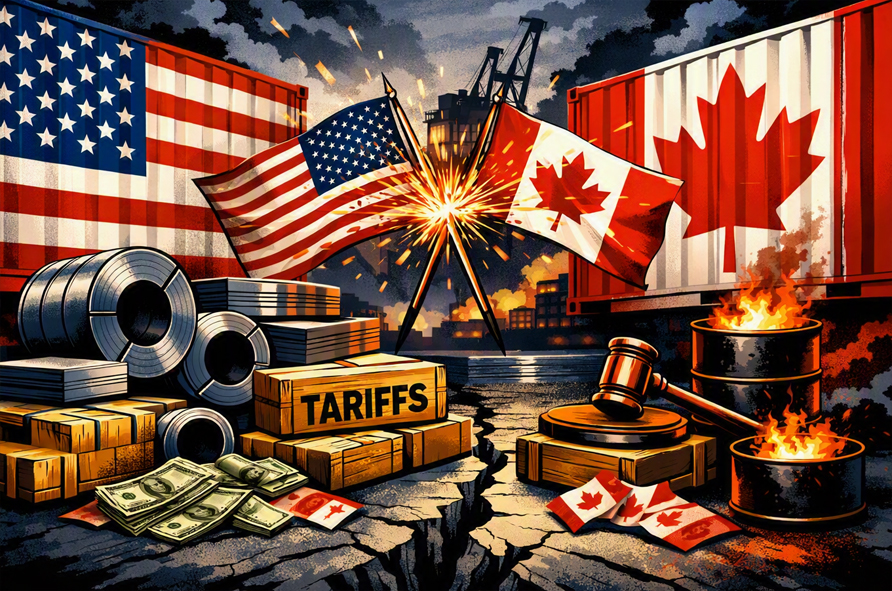
Prime
Minister
Mark
Carney’s
government
announced
Tuesday
that
Canada
will
impose
retaliatory
tariffs
on
approximately
$20
billion
worth of
U.S.
imports,
matching
the
value of
the
latest
American
tariffs
on
Canadian
goods.
(Tell Us
USA Ai
image) |
|
|
Canada
Strikes
Back as
Trump
Tariffs
Escalate
North
American
Trade
War
Charles
Mosley -
Business/Economy/Money
Tell Us
USA News
Network
DETROIT
/ OTTAWA
—
Canada
is
striking
back
against
President
Donald
Trump’s
latest
tariffs,
escalating
the
trade
confrontation
between
the two
longtime
economic
partners
and
raising
the
prospect
of a
broader
North
American
trade
war.
Prime
Minister
Mark
Carney’s
government
announced
Tuesday
that
Canada
will
impose
retaliatory
tariffs
on
approximately
$20
billion
worth of
U.S.
imports,
matching
the
value of
the
latest
American
tariffs
on
Canadian
goods.
The
Canadian
measures
will
range
from 15%
to 50%
and
cover
roughly
700
American
products,
including
steel,
aluminum,
appliances,
electronics,
machinery,
clothing,
furniture,
paper
products
and
prepared
foods.
The
Canadian
tariffs
are
scheduled
to take
effect
September
8,
giving
businesses
and
consumers
nearly
two
weeks to
prepare.
The move
follows
the
collapse
of
U.S.-Canada
trade
negotiations
and the
Trump
administration’s
decision
to
impose
new 50%
tariffs
on a
range of
Canadian
imports,
which
took
effect
August
22.
Canadian
officials
have
characterized
the
American
measures
as an
economic
attack
and say
Ottawa
can no
longer
rely
solely
on
negotiations
to
protect
Canadian
businesses
and
workers.
Ottawa
takes a
targeted
approach
Rather
than
imposing
tariffs
across
the
entire
U.S.
economy,
Canada
says its
response
is
deliberately
targeted.
Officials
selected
products
where
American
manufacturers
and
exporters
could
feel
significant
pressure
while
attempting
to limit
damage
to
Canada's
own
economy.
Canadian
officials
have
also
indicated
that the
tariff
strategy
is
designed
to
create
political
pressure
in
specific
U.S.
states,
particularly
states
with
industries
that
depend
heavily
on
Canadian
consumers.
Among
the
products
affected
are
goods
such as
paper,
plywood,
steel
products,
clothing
and
seafood.
Canada
is also
holding
back
from
targeting
some
strategically
important
imports,
including
energy
and
potash,
reflecting
the deep
integration
of the
two
countries'
economies.
Billions
in aid
for
Canadian
businesses
Ottawa
is
pairing
its
retaliatory
tariffs
with a
C$7.5
billion
support
package
for
Canadian
companies
and
workers
affected
by the
trade
conflict.
The
program
includes
interest-free
loans
and
repayment
relief
intended
to help
businesses
survive
the
disruption
while
the
government
seeks
new
markets
and
investment
opportunities.
The
Canadian
government
is
simultaneously
encouraging
consumers
to buy
Canadian-made
products
and is
accelerating
efforts
to
diversify
trade
beyond
the
United
States.
Trump
threatens
further
escalation:
The
dispute
could
become
considerably
more
serious.
Trump
has
threatened
additional
tariffs
on
Canadian
automobiles,
trucks
and
automotive
parts,
potentially
reaching
50%
beginning
January
1, 2027.
That
threat
is
particularly
significant
because
the
North
American
auto
industry
relies
on
highly
integrated
supply
chains
that
cross
the
U.S.-Canadian
border
multiple
times
during
the
manufacturing
process.
Ontario,
Canada's
industrial
heartland,
could be
particularly
vulnerable
because
of its
automobile
manufacturing
base and
extensive
economic
relationship
with
Michigan
and
other
Great
Lakes
states.
Ontario
Premier
Doug
Ford has
called
for an
aggressive
response
and has
even
raised
the
possibility
of using
Canada's
electricity
exports
as
leverage
in the
dispute.
Michigan
and the
Great
Lakes
could
feel the
impact
The
escalating
dispute
is
particularly
important
for
Michigan
and the
Detroit-Windsor
region,
where
manufacturing,
transportation,
energy
and
cross-border
commerce
depend
heavily
on the
uninterrupted
movement
of goods
between
Canada
and the
United
States.
The two
countries
conduct
nearly
$900
billion
in
annual
trade,
making
the
relationship
one of
the
world's
most
deeply
integrated
bilateral
trading
partnerships.
That
means
tariffs
imposed
on one
side can
quickly
translate
into
higher
costs on
the
other.
Manufacturers
may face
more
expensive
components,
while
consumers
could
see
higher
prices
for
products
ranging
from
food and
household
goods to
paper
products
and
appliances.
A
dispute
bigger
than
tariffs
The
confrontation
is
increasingly
moving
beyond
economics.
Carney
has
framed
Canada's
response
as a
defense
of
national
sovereignty,
while
Trump
has
continued
to
pressure
Ottawa
over
trade
and
other
political
issues.
The
breakdown
in
negotiations
has also
raised
questions
about
the
future
of the
U.S.-Mexico-Canada
trade
agreement,
which
remains
the
foundation
of North
American
commerce.
Despite
the
increasingly
hostile
rhetoric,
a
negotiated
settlement
remains
possible.
Analysts
note
that
some of
the most
damaging
potential
tariffs
have
been
delayed,
leaving
both
governments
with an
opportunity
to
return
to
negotiations.
For now,
however,
Canada
is
signaling
that it
is
prepared
to fight
back.
The
message
from
Ottawa
is
increasingly
clear:
Canada
will
defend
its
economy,
protect
its
sovereignty
and make
the
United
States
pay an
economic
price if
Washington
continues
escalating
tariffs.
The
danger
for both
countries
is that
a
dispute
that
began
with
tariffs
could
develop
into a
prolonged
restructuring
of one
of the
world's
most
important
trading
relationships
— with
businesses,
workers
and
consumers
on both
sides of
the
border
ultimately
paying
the
price.
*Portions
of this
news
report
is AI
generated
and can
make
mistakes
|
|
|
|
|
|
|
|
|




 I
HI TECH NEWS
I
SPORTS
I
I
HI TECH NEWS
I
SPORTS
I