|
|
|
|
|
|
 |
|
|
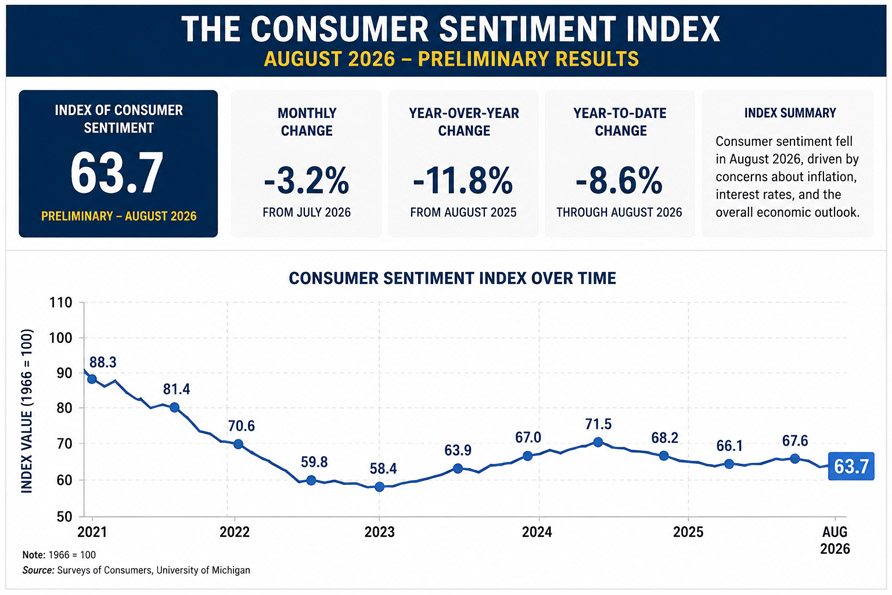
U.S.
consumer
sentiment
fell
nearly
8% in
August
2026,
dropping
to 51.0
from
55.2 in
July.
Released
by the
University
of
Michigan
Surveys
of
Consumers,
the
preliminary
index
ended
two
straight
months
of
gains.
Households
reported
growing
anxiety
over
high
living
costs,
gas
prices
above $4
a
gallon,
and
broader
economic
fallout
from the
Middle
East
conflict.
(Chart
created
by Tell
Us USA
News
Netwoork) |
|
|
August
Sentiment
Drops
Near 8
Percent
as
Households
Worry
Over
Rising
Costs
Charles
Mosley -
Economy/Money
Tell Us
USA News
Network
WASHINGTON
- U.S.
consumer
sentiment
experienced
a sharp
downturn
in early
August,
halting
two
consecutive
months
of
modest
economic
optimism
as
persistent
inflation
concerns
and
geopolitical
volatility
weighed
on
household
expectations.
According
to
preliminary
results
from the
University
of
Michigan’s
Surveys
of
Consumers
released
Friday,
the
Consumer
Sentiment
Index
fell
nearly 8
percent
to 51.0
in
August,
down
from a
final
reading
of 55.2
in July.
The
figure
fell
short of
Wall
Street
estimates,
where
economists
had
anticipated
a milder
dip to
around
54.5.
The drop
reflects
mounting
anxiety
over
persistent
cost-of-living
pressures,
heightened
by
ongoing
conflict
in the
Middle
East and
sustained
pressure
at the
fuel
pump.
While
personal
financial
expectations
saw
minor
changes,
consumer
expectations
for
short-term
business
conditions
plunged
11
percent,
and
long-term
outlooks
tumbled
17
percent.
Year-ahead
inflation
expectations
edged up
to 4.3
percent,
up from
4.2
percent
in July
and well
above
pre-conflict
baselines.
Five-year
inflation
expectations
held
steady
at 3.3
percent.
Only 8
percent
of
survey
respondents
expect
their
household
income
growth
to
outpace
inflation
over the
coming
year, a
steep
decline
from 18
percent
recorded
in late
2024.
Although
the
early-month
weakening
in
sentiment
was
pervasive
across
various
demographic
groups,
notably
large
reductions
were
seen
among
older
consumers,
lower-income
consumers,
and
those
without
a
college
degree,
said
Joanne
Hsu,
Director
of the
Surveys
of
Consumers.
These
groups
are all
particularly
vulnerable
to any
erosion
of
purchasing
power
stemming
from
inflation.
The
sentiment
report
coincides
with
official
data
from the
Commerce
Department
showing
that
U.S.
retail
sales
fell 0.6
percent
in July,
the
largest
single-month
decline
in over
a year.
The drop
in
retail
spending,
led by
pullbacks
in
online
shopping
and auto
sales,
suggests
that
consumer
spending
fatigue
may be
setting
in after
a strong
first
half of
the
year.
While
headline
inflation
has
moderated
slightly
to 3.4
percent
year-over-year,
prices
for
everyday
essentials
like
gasoline
and food
remain
elevated,
keeping
household
budgets
tight
and
consumer
caution
high
heading
into the
late-summer
spending
period.
|
|
|
|
|
|
|
|
|




 I
HI TECH NEWS
I
SPORTS
I
I
HI TECH NEWS
I
SPORTS
I