|
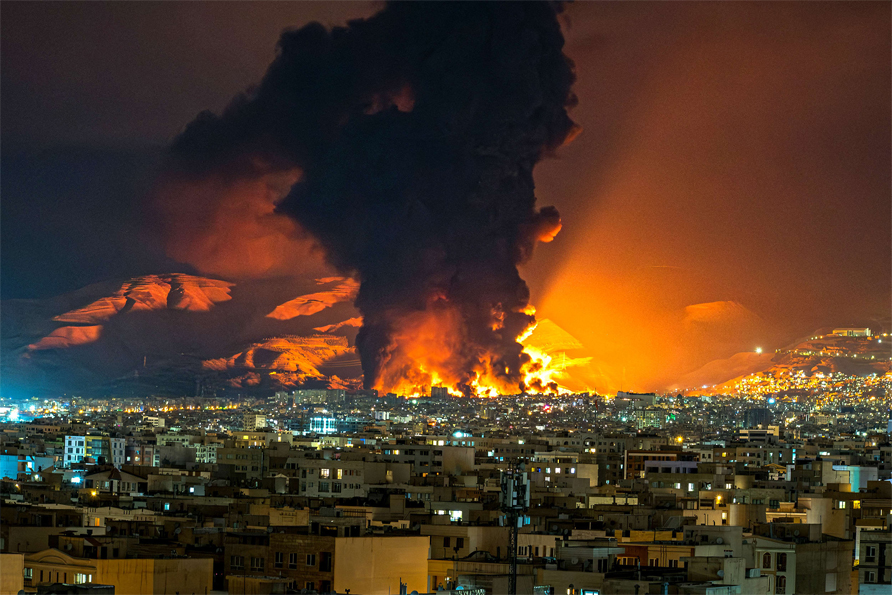
Smoke
and
flames
rise at
the site
of
airstrikes
on an
oil
depot in
Tehran
on
Saturday.
Sasan /
Middle
East
Images /
AFP via
Getty
Images |
|
|
|
|
|
 |
 |
 |
|
|
|
|
|
|
|
|
|
|
| |
Waves of
Fire on
Day 14:
US and
Israeli
Strikes
Escalate
Across
Iran and
Lebanon
Daoud
Al-Jaber
- Middle
East
Affairs
Analysis
Tell Us
Worldwide
News
Network
BEIRUT -
The sky
above
Tehran
glowed
again
last
night.
For the
fourteenth
consecutive
day, the
thud of
explosions
rolled
across
the
Iranian
capital
as
Israel's
military
announced
the
start of
yet
another
extensive
wave of
strikes
on
regime
infrastructure
— a
phrase
now so
routine
it has
become
grimly
familiar
to the
correspondents
huddled
in press
shelters
from
Beirut
to
Baghdad.
What
began on
the
night of
February
28 as a
joint
US-Israeli
campaign
with
declared
objectives
—
eliminating
Iran's
nuclear
programme,
its
missile
arsenal,
and
ultimately
its
leadership
— has
metastasized
into
something
far less
defined,
and far
more
dangerous.
US
Central
Command
has
confirmed
that
American
forces
have
struck
more
than
5,000
targets
inside
Iran
since
the
operation
began.
The
Pentagon
describes
a
systematic
dismantling
of
Iran's
military
infrastructure
— its
navy,
air
defenses,
radar
networks,
ballistic
missile
sites,
and
nuclear
facilities.
President
Trump,
speaking
in
Kentucky
on
Wednesday,
told
supporters
that he
had won,
before
contradicting
himself
hours
later by
telling
reporters
the
campaign
was not
finished.
It is a
dissonance
that
captures
the fog
at the
heart of
Washington's
war
aims.
On the
ground
in
Tehran,
the
picture
is far
bleaker
than the
victory
laps in
Washington
suggest.
Iran's
UN
representative
reports
that
more
than
1,348
civilians
have
been
killed —
a figure
the
Iranian
Red
Crescent
broadly
corroborates.
Among
the dead
are more
than 160
people
killed
in a
single
strike
on a
girls'
school,
an
incident
now
under
separate
UN
investigation.
Eleven
healthcare
workers
are
confirmed
dead,
four of
them
physicians.
The
World
Health
Organisation
has
identified
at least
thirteen
Iranian
health
infrastructure
sites
damaged
or
destroyed.
The
war's
most
consequential
act came
early:
on March
1,
Israeli
strikes
killed
Supreme
Leader
Ali
Khamenei,
whose
compound
was
obliterated
in the
opening
hours of
the
campaign.
His son,
Mojtaba
Khamenei
—
reported
to have
suffered
a
fractured
foot and
minor
injuries
in the
first
wave —
has
since
been
selected
as
successor
by a
hastily
convened
leadership
body.
How much
authority
the
younger
Khamenei
wields
over an
increasingly
battered
state
apparatus
remains
deeply
unclear.
Lebanon
did not
ask for
this
war. But
Lebanon
is now
inside
it. On
March 2,
four
days
into the
Iran
strikes,
Hezbollah
fired
its
first
rockets
into
northern
Israel
since
the
fragile
2024
ceasefire
—
targeting
a
missile
defense
site
south of
Haifa.
Hezbollah's
secretary-general
Naim
Qassem
framed
it as a
defensive
act
following
Khamenei's
assassination
and more
than a
year of
near-daily
Israeli
operations
inside
Lebanon
that had
never
truly
honoured
the
truce.
Israel's
response
was
immediate
and
overwhelming.
Since
that
first
salvo,
Lebanon's
Health
Ministry
has
confirmed
at least
680
people
killed
and more
than 600
wounded.
Over
800,000
Lebanese
have
been
displaced
— the
second
mass
displacement
this
country
has
endured
in less
than two
years.
The UN
High
Commissioner
for
Human
Rights
warned
this
week
that
Lebanon
risks
becoming
a key
flashpoint
and
called
for an
immediate
cessation
of
hostilities.
Israeli
forces
have
been
issuing
evacuation
orders
ahead of
strikes
on
Beirut's
southern
suburbs,
warning
residents
to save
their
lives
and
leave.
Among
the
specific
strikes
drawing
international
censure:
a
residential
building
in
central
Beirut
was
bombed,
causing
fires
across
several
floors.
In the
village
of Arki,
near
Sidon,
nine
people
were
killed
in a
single
strike —
five of
them
children.
A hotel
building
in
central
Beirut
was
struck,
killing
four
senior
commanders
from
Iran's
Quds
Force
who
Israeli
military
intelligence
said
were
planning
operations
against
Israel.
Near
Tripoli,
Israel's
navy
killed a
Hamas
commander
in the
first
reported
strike
on that
part of
the
country
since
the war
began.
An
Israeli
air
force
strike
also
killed a
senior
Hezbollah
commander,
Zaid Ali
Jumaa,
described
by the
IDF as a
key
figure
in the
group's
rocket
and
drone
operations.
Israel
said it
destroyed
a
Hezbollah
drone
warehouse
and what
it
called a
leadership
headquarters.
Four
Iranian
diplomats
were
killed
in a
separate
Beirut
strike —
an act
Tehran
has
condemned
at the
UN
Security
Council
as a
terrorist
attack.
Iran
warned
that any
attack
would be
met with
retaliation
against
US
military
bases
across
the
region.
It was
not an
idle
threat.
The
Islamic
Revolutionary
Guard
Corps
has now
confirmed
strikes
on at
least 27
bases in
the
Middle
East
where
American
troops
are
deployed.
Seven US
service
members
are
dead;
140
others
have
been
wounded,
according
to the
Pentagon.
Iran's
operations
have
touched
nine
countries:
Bahrain,
Iraq,
Jordan,
Kuwait,
Oman,
Qatar,
Saudi
Arabia,
Turkey,
and the
United
Arab
Emirates.
A
British
military
base on
Cyprus
was
struck
by an
Iranian
drone.
In the
Strait
of
Hormuz —
through
which
approximately
one-fifth
of the
world's
crude
oil
flows —
the US
military
destroyed
sixteen
Iranian
minelayers
before
they
could
complete
the
seeding
of the
waterway.
Trump
has
insisted
Iran did
not
succeed
in
laying
any
mines.
Oil
prices
have
surged
to their
highest
level
since
September
2023. In
Iraq,
two
foreign
oil
tankers
came
under
attack
in
territorial
waters,
their
crews
later
rescued.
Two
people
were
killed
in Oman
after a
drone
was
brought
down in
Sohar
province.
On
Wednesday,
the IRGC
claimed
a joint
operation
with
Hezbollah
involving
five
consecutive
hours of
sustained
fire
that
struck
more
than
fifty
targets
across
Israel.
Fifteen
Israelis
have
been
killed
and more
than
2,000
wounded
since
the
conflict
started.
Nine
were
killed
in a
single
Iranian
ballistic
missile
strike
on Beit
Shemesh
on March
1.
Israel
has
declared
a
nationwide
state of
emergency.
The
United
Nations
is now
warning
of toxic
black
rain —
contaminated
precipitation
carrying
industrial
pollutants
from
strikes
on fuel
depots
and oil
facilities,
mixing
with
rain
clouds
over
Tehran
and
surrounding
areas.
The WHO
has
flagged
catastrophic
risks to
civilian
health.
Strikes
have
also
damaged
Golestan
Palace,
the
Azadi
Sports
Complex,
and the
historic
sites of
Isfahan
—
including
Naqsh-e
Jahan
Square,
the Shah
Mosque,
and
Chehel
Sotoun —
all
UNESCO
World
Heritage
Sites. A
medieval
fortress
at
Falak-ol-Aflak
was also
hit.
There is
no
ceasefire
in
sight.
Iran's
foreign
minister
this
week
flatly
rejected
any
resumption
of
nuclear
talks,
saying
Tehran
is
prepared
for the
possibility
of a US
ground
invasion.
The
White
House
has
articulated
a demand
for
unconditional
surrender.
A UN
Security
Council
resolution
passed
this
week
called
on Iran
to halt
its
strikes
on Gulf
states —
but
notably
omitted
any
mention
of US or
Israeli
strikes
on Iran
or
Lebanon.
Britain's
Prime
Minister
Sir Keir
Starmer,
alongside
the
leaders
of
France
and
Germany,
condemned
Iran's
counter-strikes
and
called
for a
return
to
diplomacy
— while
stressing
that he
did not
believe
in
regime
change
from the
skies.
France
denied
use of
its
military
bases
for
offensive
US
flights,
provoking
a threat
of
economic
retaliation
from
Washington.
Spain
issued a
similar
denial.
Canada
said it
could
not rule
out
participation
in the
coalition.
Lebanon's
government
has
unequivocally
condemned
Iranian
attacks
on its
Gulf
Arab
neighbours
and
reiterated
it does
not need
Hezbollah
to
defend
Lebanese
sovereignty
— a
position
that
rings
increasingly
hollow
as
Israeli
bombs
continue
to fall
on
Beirut.
Fourteen
days in,
this war
has
already
killed
more
than
1,700
people
across
multiple
countries,
displaced
nearly a
million,
threatened
one of
the
world's
most
critical
energy
chokepoints,
damaged
irreplaceable
world
heritage,
and
brought
the
Middle
East
closer
to an
uncontrollable
regional
conflagration
than at
any
point
since
2003.
The
objectives
declared
on
February
28 —
regime
change,
nuclear
disarmament,
the
destruction
of
Iran's
military
— remain
as
distant
as ever.
What is
no
longer
distant
is the
prospect
that
this
conflict,
born of
calculation
and
hubris,
could
outlast
any of
the
plans
made to
contain
it.
Casualty
figures
are
subject
to
ongoing
revision.
Due to
restricted
media
access
in Iran,
some
events
cannot
be
independently
verified.
|
|
|
|
|
|
|
|
|

 I
HI TECH NEWS
I
SPORTS
I
I
HI TECH NEWS
I
SPORTS
I